Story and Lore of Into the Fire
An island older than science. A catastrophe that wakes something ancient. The story is told in the ruins.
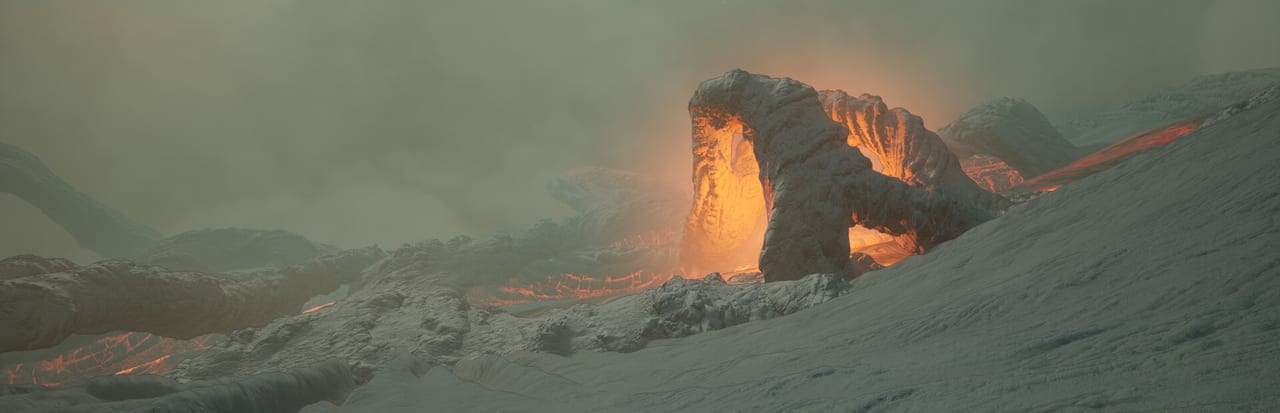
Into the Fire tells its story the way a volcanic eruption tells time: through pressure, heat, and things that surface when the ground gives way. Open Playtest no.2 added a Main Quest plus Area and Gate jobs, so there is now a board. The story still does not live in a cutscene button. It arrives in survivor conversations, in the names on your extraction manifest, in quest text that points at a district, in the symbols carved deeper than the magma tunnels, and in the moments when a street starts behaving like a ritual instead of a disaster.
This page is for players who want to know what they are walking into before they walk in. Read it before your first expedition or after a few runs when the story starts speaking.
Dante’s Archipelago — the setting
The game takes place on Dante’s Archipelago, a remote cluster of volcanic islands. The name is a clue. Starward Industries has described the setting as drawing from Dante Alighieri’s Divine Comedy — not literally, but in spirit. The archipelago functions as a descent: from the surface catastrophe of a volcanic eruption, through layers of escalating danger, toward something older and colder at the bottom.
The eruption is not a natural disaster in isolation. The interviews describe it as a chain-reaction event — one volcano triggering others, ash and gas reshaping weather patterns, and the physical terrain changing in real time as lava rewrites the map. Your knowledge of New Sindra from last week’s run is a rough draft, not a blueprint.
The archipelago includes several districts referenced in playtest footage and official materials:
- New Sindra — the primary city zone, apparently the largest named district. Playtests describe it as a dense urban area with multi-floor buildings, tight corridors, and a mix of residential and commercial structures.
- Crimson Pass — a high-threat district graded at three skulls. References suggest it is a more open or elevated zone with longer sightlines and more exposure to volcanic hazards.
- The Ruins — a vertical zone. Playtests mention ladders, ziplines, and the ability to use vertical space as a survival tool. Also appears to be the zone where the vertical routes in extraction are most important.
Not all districts are confirmed by name. Store copy, interviews, and playtest footage suggest the archipelago has at least four to six distinct zones with different structural types, hazard profiles, and survivor densities.
The catastrophe — what is happening
The official description calls it a chain-reaction volcanic eruption. What makes it catastrophic is not the size — it is the scope. Multiple volcanoes across the archipelago are active simultaneously. Lava flows are reshaping terrain between runs. Ash clouds are altering visibility and air quality. The environment is evolving in real time, not as a scripted sequence but as a systemic outcome of the eruption.
The disaster is not a background event. The threat meter in camp ticks regardless of whether you are out on an expedition. The island is the antagonist, and it does not take days off.
The science layer — volcanology as mechanic
Starward Industries has described the game’s approach to volcanology as inspired by real disaster science. The retro-futuristic aesthetic draws from early-to-mid 20th century volcanology: brass instruments, seismographs, hand-cranked radios, and gear designed before digital sensors made everything quiet.
This is not just visual. Seismographs are a gameplay tool. You read volcanic activity to time your runs. The seismograph is referenced in both the controls and the volcanic hazards guide. Radio callouts from camp communicate seismic events in real time. The game wants you to read the mountain the way a real volcanologist reads warning signs.
The retro tech aesthetic is also a gameplay framing: Frank is using equipment that predates digital convenience. The tools are analog, the stakes are real, and the margin for error is narrow.
The myth layer — what the volcano wakes
This is where Into the Fire stops being a disaster simulation and becomes something stranger. The interviews and store copy explicitly reference “ancient legends” and “mythology” meeting the science of the eruption.
Specific references from official materials:
- The archipelago contains ruins, sacred temples, and structures that predate the scientific stations on the island
- Environmental anomalies are described as tied to whatever is under the island — not geological, not purely supernatural, but something between
- Fire spirits are described as entities, not effects — they have behavior patterns and are tuned to respond to specific tool types
- Survivors who have been on the island longer reference rituals, symbols, and forces that hint at a dimension beyond the eruption
Starward describes the narrative as blending scientific language with mythological language. When a district starts behaving like a ritual, you are not missing a keybind. You are in the story.
The common room in camp is where the story conversations happen. Survivors talk. Some share rumors. Some want to go deeper. Some want to leave. The tension between those goals is how the writing expresses itself in a game where Frank is a rescuer, not an explorer.
The story through rescue
The narrative is delivered through the extraction manifest. Who you save, what they know, and what they ask you to find next — these are the story beats. Named survivors are referenced in playtest footage as having specific knowledge and agendas.
This means the story is partially procedural. Two players who run the same district in different weeks may encounter different survivors and different conversation threads, depending on camp state and previous extractions.
The camp hub guide covers how survivors reshape camp. The connection between camp development and story progression is deliberate: the more you extract, the more the camp knows, and the more the camp knows, the more the story surfaces.
Former title: Dante’s Ring
The game was announced under the working title Dante’s Ring. Starward officially rebranded to Into the Fire in March 2025, describing the new title as more accurately representing the gameplay and emotional core.
Dante’s Ring referenced the archipelago’s volcanic geography — a ring of islands surrounding a central caldera. That geography is still in the game. The title change does not represent a redesign. If you encounter references to Dante’s Ring in old coverage, you are looking at the same game.
How this wiki covers the story
This page will be updated as official story details surface through playtests, Starward interviews, and Early Access launch. The roadmap tracks when new story content is expected. The playtest notes will surface any narrative reveals that come through the test waves.
Do not look for a walkthrough of the story here. Look for orientation. The story is personal and replay-shaped. The wiki’s job is to tell you the island is real, the catastrophe is not clean, and the myth layer is not decoration.
Read the beginner’s guide if you want to know how to survive your first expedition. Read this page if you want to know why you are going back in.
Frequently Asked Questions
Quick answers to the most common questions.
Is Into the Fire connected to The Invincible?
No. Both games are from Starward Industries, but The Invincible is a different IP set in a different universe. Into the Fire shares the studio's approach to atmosphere and discovery, not the setting.
Do I need to understand the Dante's Ring name to play?
No. Dante's Ring was the working title. The archipelago is still called Dante's Archipelago in-game. You do not need to know the Divine Comedy to play the game.
Is the story optional?
The story elements are woven into the gameplay loop, not separate from it. You can complete extraction runs without engaging the myth layer. But the story is in the conversations and the environments whether you are looking for it or not.
Are the fire spirits enemies or environmental effects?
Playtest footage treats fire spirits as entities with behavior. They are blockers and pressure sources, not enemies in the combat game sense. See volcanic hazards for how to handle them.